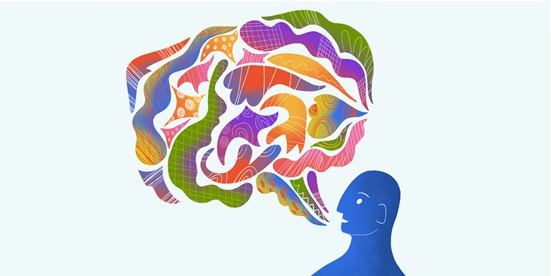
Have you ever had a completely silent conversation with someone across a crowded room? It is often said that a staggering portion of human communication—some estimates suggest as much as 93%—is nonverbal. While spoken language defines our regional identities, our ability to read body language, gestures, and silence defines our emotional intelligence.
In a world that never stops talking, some cultures have elevated the unspoken to an art form. Understanding these silent signals is not just a fascinating anthropological study; it is a crucial skill for global travellers and international business leaders. Let’s embark on a journey to discover the nations that speak the loudest without uttering a single word.
The Spectrum of Silence: High-Context vs. Low-Context
To understand who masters nonverbal communication, we must first examine the framework of “context” within culture. Anthropologists categorise world cultures into “high-context” and “low-context” societies, a distinction that profoundly influences how information is exchanged.
- High-context cultures rely heavily on implicit communication and non-verbal cues. In these societies, the message is often conveyed through the physical setting or the person’s status, rather than just the words spoken.
- Japan: Silence is a form of respect and contemplation.
- Arab Nations: Eye contact and proximity convey intensity and sincerity.
- Latin America: Touch and gestures are central to building trust.
- Low-context cultures, conversely, prioritize direct verbal communication where the mass of information is vested in the explicit code.
- USA: “Say what you mean and mean what you say.”
- Germany: Precision and clarity are valued over nuance.
- Scandinavia: Verbal directness is preferred to avoid ambiguity.
Ultimately, neither approach is superior; they simply represent different ways of processing the human experience. Grasping this fundamental divide is the key that unlocks the door to true cross-cultural understanding.
Visual Fluency in a Digital World
The ability to read situations without words is not limited to physical interactions; it translates seamlessly into the digital realm, where visual cues are paramount. We navigate interfaces, interpret icons, and react to graphical feedback instantly, often relying on a universal visual language that transcends borders.
For instance, modern entertainment platforms rely on this intuitive communication to engage users from diverse linguistic backgrounds. A prime example is casino Verde, where the user interface is designed to be instantly understood through visual cues rather than dense text. The vibrant graphics and intuitive layout enable players to navigate complex games effortlessly, demonstrating that a well-designed visual system can resonate with everyone, regardless of their native language.
The Virtuosos of Gesture: Italy and the Mediterranean
If non-verbal communication were a sport, Italy would undoubtedly be the reigning Olympic champion. For Italians, gestures are not merely an accompaniment to speech; they are a fully functioning lexicon capable of telling entire stories.
Walking through the streets of Rome or Naples, you will witness a symphony of hand movements that convey precise meanings. This reliance on gesture dates back centuries, possibly arising as a means of communication across a fragmented peninsula with numerous dialects. Today, it remains a vital part of the Italian identity, allowing for expression that is both passionate and precise.
Common Italian Non-Verbal Cues
To truly navigate the social landscape of the peninsula, one must become familiar with its most iconic manual signals. These physical expressions are so ingrained in daily life that they often replace spoken sentences entirely, offering a shorthand for complex emotions.
- The pinecone (Che vuoi?): Fingertips bunched together, moving up and down—meaning “What do you want?” or “What are you saying?”
- The chin flick: Brushing the back of the fingers under the chin—signifying “I don’t care” or indifference.
- The cheek screw: Twisting the index finger into the cheek—meaning “delicious” or “good.”
The Art of Subtlety: Japan and East Asia
While the Mediterranean represents the expressive, outward side of the non-verbal spectrum, East Asia, particularly Japan, represents the mastery of inward subtlety. Here, what is not said is often more important than what is spoken aloud.
In Japanese culture, the concept of “Kuuki wo Yomu” (“reading the air”) is essential for maintaining social harmony. It requires individuals to assess the mood of a room and the feelings of others without needing explicit verbal confirmation. This high-context environment creates a society where silence is not awkward but comfortable and communicative.
Key Aspects of Japanese Silent Etiquette
Foreign visitors often find these subtle behaviors challenging to interpret, yet they are the fundamental building blocks of Japanese social interaction. Mastery of these silent codes demonstrates a deep respect for the culture and significantly smooths the path of communication.
- Bowing (Ojigi): The depth and duration of a bow communicate status, respect, gratitude, or apology far better than a handshake.
- Eye contact: Prolonged eye contact can be seen as aggressive; avoiding it is often a sign of respect, unlike in the West.
- The smile: In Japan, a smile can mask embarrassment, confusion, or anger, serving as a social armor rather than just an expression of joy.
The Unspoken Symphony of Global Interaction
Mastering the art of non-verbal communication opens doors that language alone cannot unlock. It allows us to empathize with others, navigate foreign environments with grace, and appreciate the nuance of human interaction.
Whether it is the animated hands of an Italian merchant, the respectful bow of a Japanese host, or the intuitive design of a digital interface, these silent signals connect us. As you travel or browse the web, pay attention to the unspoken. You might find that the most profound things are said when no one is speaking at all.