Britain’s cities are often described through eras — Roman, medieval, Georgian, Victorian, modern — as though time arrived in neat packages and then moved on. Walking their streets tells a different story. History here is cumulative. New ideas settle beside old ones. Streets evolve without forgetting why they were first laid out.
What gives Britain’s great cities their character is not a single period, but the way multiple eras remain active at once. Georgian order coexists with medieval instinct. Glass rises beside stone. The result is not contrast for effect, but continuity shaped by use.
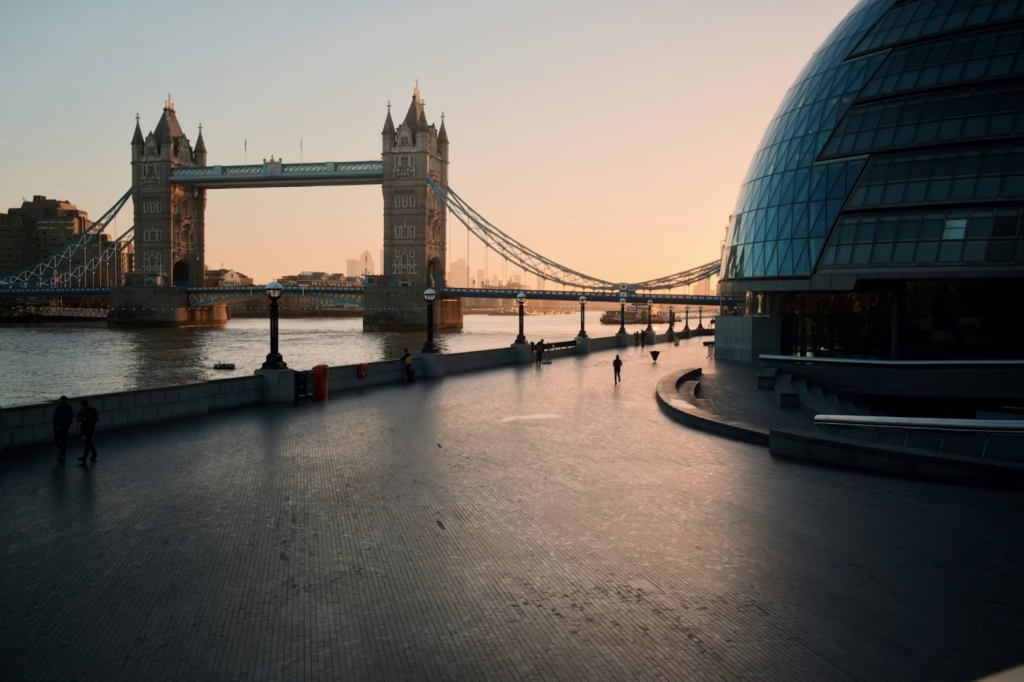
Order, Proportion, and Accumulation in London
London is often described as sprawling, yet much of its power comes from structure. Georgian squares impose rhythm and restraint on a city otherwise defined by expansion. Terraces repeat. Proportions hold. Space is given room to breathe.
These squares were not designed as decoration. They were social infrastructure — places for movement, gathering, and pause. That function remains intact. Modern life folds easily into these forms because they were built to adapt.
London’s medieval past still surfaces, too. Curved streets interrupt grids. Unexpected alleys redirect flow. The city doesn’t smooth these irregularities away. It builds around them, allowing different logics to coexist.
Movement as Cultural Continuity
Rail travel plays a quiet but essential role in maintaining this cohesion. Trains follow long-established corridors, reinforcing relationships between cities rather than isolating them.
For travellers choosing to book train tickets, the experience often feels integrated rather than transitional. Stations sit within historic cores. Arrival places you directly into the city’s rhythm, not on its edge.
Movement here supports continuity rather than disruption.
Streets That Remember Their Purpose
What distinguishes London is not preservation, but persistence. Markets remain markets. Thoroughfares still guide movement. Neighbourhoods retain identities shaped by centuries of repetition.
Modern architecture rises confidently, but rarely at street level where daily life unfolds. Towers signal ambition from a distance. At ground level, the city remains human in scale, guided by routes older than the buildings that now line them.
History here is not framed as spectacle. It is operational.
Moving North Without Breaking the Thread
Travel between Britain’s cities reinforces this sense of continuity. The landscape shifts, but the logic of settlement remains recognisable.
Taking the London to Edinburgh by train allows the transition to unfold gradually. Urban density thins. Fields widen. Towns appear in patterns shaped by trade and terrain rather than design trends. Movement feels additive, not interruptive.
Journeys like this reflect how Britain developed — incrementally, with new layers settling onto established routes.
Elevation, Compression, and Memory in Edinburgh
Edinburgh carries its history vertically. Medieval cliffs dictate form. Streets stack. Buildings rise where land refuses to spread. The city feels compressed, but never cramped.
The Old Town reveals its past immediately — narrow lanes, sudden drops, stone worn smooth by centuries of passage. Movement here is deliberate. You climb, descend, and turn constantly, aware of terrain shaping every decision.
This physical engagement with the city creates intimacy. History is not observed from a distance; it is navigated.
Georgian Confidence on Higher Ground
Edinburgh’s Georgian New Town offers a striking counterpoint. Where the medieval core tightens, the Georgian streets open. Lines straighten. Space expands. Proportion replaces compression.
This shift does not erase what came before. It clarifies it. The city’s evolution becomes legible through contrast rather than replacement. Each era explains the other.
The New Town’s endurance lies in its flexibility. Homes become offices. Streets adapt without losing coherence. Order proves resilient when it is well considered.
Why Britain Builds by Addition
Across Britain’s cities, development tends to add rather than overwrite. New districts emerge alongside old ones. Roads widen without severing older routes. Even modern interventions often echo inherited patterns.
This additive instinct prevents fragmentation. Cities remain readable despite growth. Residents recognise their surroundings even as they change.
It also explains why heritage feels lived-in rather than protected. The past survives because it remains useful.
Medieval Instinct, Georgian Discipline
What links Britain’s great cities is not style, but balance. Medieval layouts prioritised defence, proximity, and adaptation. Georgian planning introduced order, symmetry, and civic confidence.
Together, these instincts shape cities that feel layered but stable. Irregularity exists within structure. Freedom exists within form. Neither dominates.
This balance gives British cities their distinctive texture — complex without confusion.
Cities That Carry Time Openly
Britain does not hide its history behind gates or explanations. It allows time to remain visible, functional, and occasionally inconvenient.
Streets curve when you expect straight lines. Buildings interrupt sightlines. Views open unexpectedly. These moments are not errors — they are evidence of continuity.
The city trusts residents and visitors to adjust.
Why These Cities Endure
Georgian squares and medieval cliffs endure because they still work. They support movement, gathering, and daily life without demanding interpretation.
Britain’s great cities do not resolve their past into a single narrative. They allow it to remain plural, layered, and active.
And in that openness — the willingness to carry time side by side — lies their lasting character: cities that evolve without erasure, and grow without forgetting how they first learned to stand.