South Korea reveals itself through movement rather than monuments. Cities rise quickly, but they do not sever ties with what came before. Rivers guide development. Mountains interrupt expansion. The result is a rhythm built on adjustment — between speed and stillness, density and retreat, innovation and ritual.
To understand the country, it helps to notice how people move through it. Commutes cross water. Evenings climb hills. Temples sit within reach of office towers, not removed from them. South Korea’s cultural pulse is not defined by contrast alone, but by the way these elements repeat, overlap, and settle into daily life.
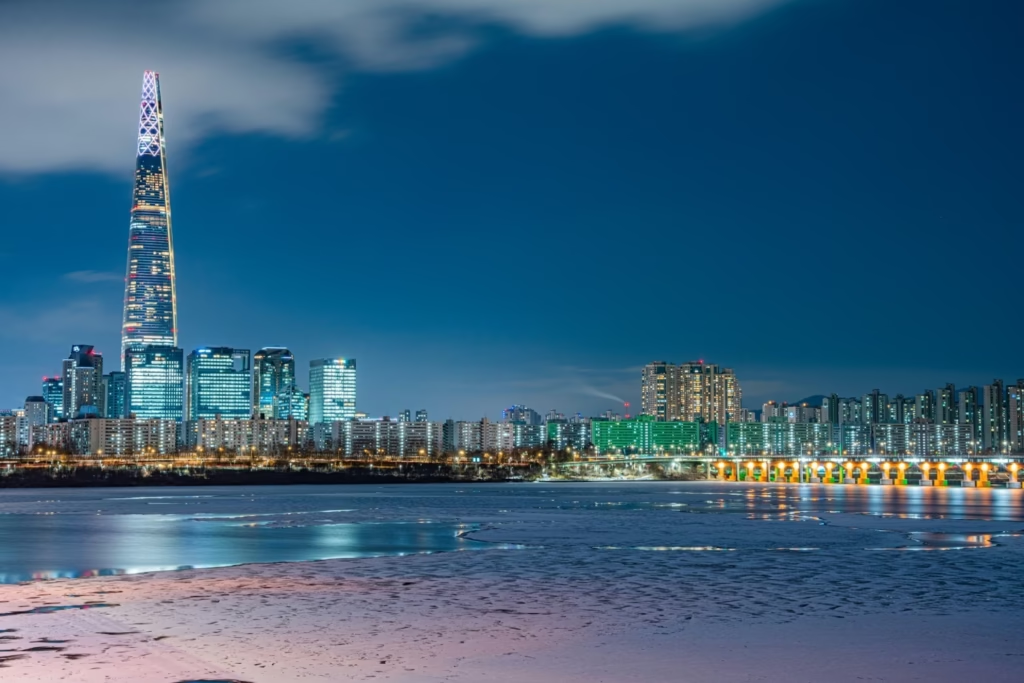
Flow and Compression Along the Han in Seoul
Seoul feels organised by the Han River more than by any single plan. Districts stretch along its banks, expanding outward while remaining tethered to the water. Bridges function as connectors rather than boundaries, allowing the city to feel continuous despite its scale.
Daily life here moves quickly, but not carelessly. Workdays are long, evenings purposeful. Cafés and riverside paths fill after dark, as though the city exhales all at once. The river absorbs this energy without reflecting it back, maintaining a sense of balance.
For travellers exploring Korea tour packages, Seoul often feels intense at first — but that intensity softens once the underlying rhythm becomes visible.
When the City Steps Aside
Despite its density, Seoul allows space to recede. Parks appear along the river. Hills interrupt neighbourhood grids. Old gates remain embedded within modern routes.
These interruptions are not decorative. They provide pause. The city does not attempt to overpower its geography; it negotiates with it. This negotiation creates pockets of quiet that feel intentional rather than accidental.
Understanding Seoul means recognising when it invites stillness — and accepting the invitation.
Speed as Structure, Not Disruption
South Korea’s infrastructure does more than move people; it regulates tempo. Trains arrive precisely. Transitions are smooth. Waiting rarely feels wasted.
Travel by KTX train compresses distance without flattening experience. Cities remain distinct, but the effort required to move between them disappears. This ease changes how the country is perceived — not as a collection of isolated destinations, but as a connected system.
Speed here is not spectacle. It’s an expectation that allows everything else to function calmly.
Ascending Into Stillness
Leaving the river behind introduces a different cadence. Paths rise. Sound fades. The city loosens its grip gradually, not abruptly.
Mountain temples around Seoul are not isolated retreats. They remain part of the city’s orbit, accessible yet distinct. The climb itself becomes a transition — from horizontal movement to vertical effort, from urgency to attention.
Here, time behaves differently. Movement slows because the terrain insists on it.
Ritual Without Distance
Mountain temples in South Korea are not staged for viewing. They function. Bells mark time. Paths wear smooth under repeated use. Ritual unfolds quietly, without explanation.
Visitors often expect formality. What they encounter instead is familiarity. Monks pass without ceremony. Worshippers arrive and leave without spectacle. Sacred space remains integrated rather than elevated.
This accessibility keeps tradition alive. Ritual persists because it remains part of routine.
Southward Momentum in Busan
Busan approaches rhythm differently. Where Seoul concentrates, Busan opens. The city spreads along the coast, shaped by water and wind rather than a single river.
Life here feels outward-facing. Markets extend toward the sea. Streets slope and curve. The port remains active, grounding the city in movement and exchange.
Busan’s pace is steady rather than fast. Energy exists, but it circulates differently — less compressed, more dispersed.
Water as Orientation
In Busan, water is not backdrop; it is reference point. Neighbourhoods orient toward the coast. Daily schedules respond to tides and weather as much as to clocks.
This relationship creates a distinct calm. Even at its busiest, the city feels breathable. Space opens where needed. Light behaves differently, reflected and softened by the sea.
Busan reminds visitors that density and openness are not mutually exclusive.
The Role of Geography in Daily Life
Across South Korea, geography remains active in shaping behaviour. Rivers organise cities. Mountains interrupt them. Coasts redirect attention.
Rather than flattening these features, development incorporates them. Infrastructure bends. Architecture adapts. Movement adjusts.
This responsiveness prevents uniformity. Cities remain distinct because they answer different landscapes.
A Culture Practised Through Repetition
What ultimately defines South Korea’s rhythm is repetition — not ritualised for effect, but lived daily. Commutes repeat. Meals anchor evenings. Temple paths wear down under steady footsteps.
Change arrives quickly here, but it does not erase habit. Innovation layers onto routine instead of replacing it. This layering creates continuity without stagnation.
Culture persists because it remains useful.
Why the Rhythm Holds
South Korea’s balance between Han River cities and mountain temples is not symbolic. It is practical. Speed requires stillness to remain sustainable. Density needs retreat to remain humane.
By allowing these elements to coexist, the country avoids fracture. Movement feels purposeful. Pauses feel earned.
The rhythm holds because it is flexible — shaped by land, reinforced by infrastructure, and renewed daily by how people choose to move through it.