
The remote work revolution has completely changed the operation of the organizations. What originally started out as a temporary measure to address circumstances in the world has become one of the new aspects of the contemporary workplaces. Heading into 2026, one of the realities that are becoming hard to ignore is remote work being here to stay, and leaders need to learn how to engage in the art of working with a distributed team. However, remote engagement is a challenge many organizations have been unable to accomplish. In the recent study conducted by Gallop, 6 out of 10 remote employees indicate that they feel emotionally detached in their jobs, which is a significant engagement crisis with direct consequences on productivity, employee retention, and organizational success.
The problem is unlike the conventional workplace engagement. Through the physical offices, informal contacts, spontaneous dialogues, and visible acknowledgement takes place automatically. Remote environments do away with such incidental points of contact, and leaders must be deliberate and purposeful concerning connection creation and continued engagement. This change requires new strategies, creative thinking, and flawless dedication on the part of the organizational leadership.
The positive aspect is that remote interaction is not only possible but also not that difficult. The companies that have invested in purposeful engagement strategies indicate increased productivity, reduced turnover, and enhanced benefit of satisfaction among remote work teams. The distinction between struggling and thriving remote organizations is usually whether leaders take engagement as a priority need or as a second thought.
Knowledge of the Special Difficulties of Remote Engagement

Working remotely exposes certain challenges of engagement, unlike working in an office. The most apparent obstacle is physical isolation. Working at home, employees get deprived of the physical signals about the culture of the company, such as the buzz in the office, the accidental conversations in the hallway, the demonstration of the leadership dedication. This separation can swiftly become the separation with the organizational purpose and coworkers.
Natural recognition is also done away with when remote work is being practised. This is because in a physical office, excellent work is often naturally observed–colleagues can hear people succeed, managers can see contributions, peers can see excellence. Remote environments make such achievements opaque giving them no visibility unless done through direct communication. This invisibility makes the remote workers feel unvalued even when they do a good job.
These problems are aggravated by the problem of communication. Quick conversations help clear misunderstandings that are usually encountered in offices. Working remotely increases the chances of miscommunication and complicates the solution. The act of Asynchronous communication introduces a delay in problem solving, decision making and connectivity. Workers who wait to receive feedback in different time zones or on an email list feel frustrated and this kills participation.
Also, remote working dissolves the lines between work and personal lives in a manner that puts sustainable engagement in question. Home-based employees find it hard to take a break and the resulting burnout is shared with social isolation. This overwork and underconnection is a particularly poisonous engagement environment.
Competitive Recognition as Starting Point of Remote Engagement
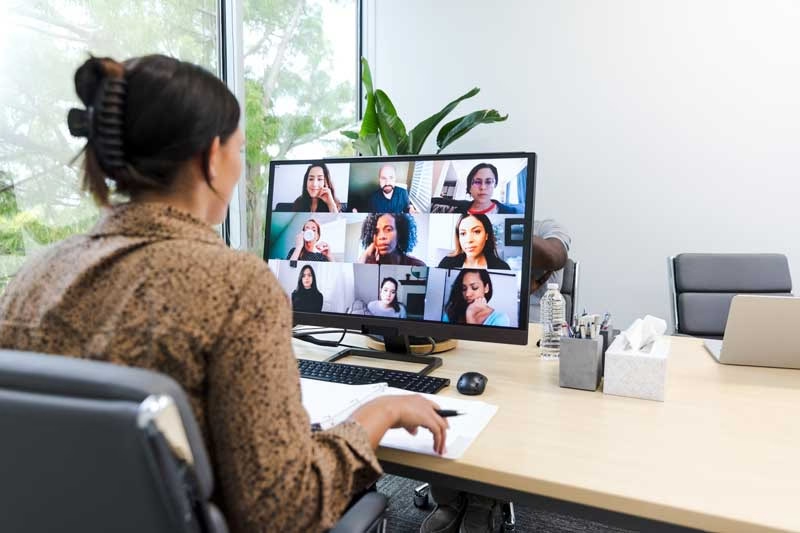
Recognition is the greatest leverage towards remote engagement. It has been found that employees who are frequently recognized are 2.7 times more likely to be highly engaged. However, recognition is not fully leveraged in distant locations by most organizations and remote personnel end up feeling unnoticed.
Remote recognition cannot be effective without going beyond the annual recognition programs or the occasional recognition. Rather, recognition has to be incorporated into the routine in which organizations have to make it common, definite, and conspicuous. Studies show that recognition is always the strategy with the greatest impact when leaders know how to effectively engage remote staff.
Proper recognition in remote environments has a number of attributes. It is also specific and it recognizes specific achievements as opposed to generic remarks like great job. It is an opportune report that is provided near the time the success is realized. It is visible, and it is shared with colleagues to make them contribute towards the contribution. It is natural and shows true appreciation as opposed to forced ones. And it is fair so that all team members are recognized regardless of the visibility and closeness to leadership.
Organizations that have established formal recognition systems cannot fail to realize observable returns. Managers who promise to recognize their team members weekly record higher scores on employee engagement. Congratulatory teams build closer friendship. When recognition is visible within an organization, the cultural values they hold are reinforced and other people are motivated to deliver at the same level.
The most advanced organizations decouple recognition and compensation eliminating the notion that recognition is transactional. They establish psychologically secure working conditions where employees of any level are familiar with each other. Through recognition, they emphasize both desired and actual behavior which may go along with what the organization values the most.
Forging Real Relationship in Virtual Teams
In addition to recognition, remote interaction needs intentional connection-making. Remote workers experience much anxiety and isolation as compared to office workers. To solve this emotional fact, leaders must be willing to provide purposeful space where genuine human connection can be fostered.
One-on-one check-ins that are structured are a basic practice. Frequent meetings between managers and working remotely employees, once or twice a week, allow having a true chance of connection, not only to talk about the work. Such meetings must discuss the actual performance of employees rather than the number of tasks that are being finished. Managers are advised to inquire about the challenges, congratulate, have career discussion, and inquire about wellbeing.
Such check-ins can have several purposes at the same time. They ensure that they have manager-employee contact even when there is distance. They give a chance to identify the achievement. They are brought up well in advance of turning into crises. They show that the organization treats employees as complete individuals, and not just as units of productivity.
Besides, the relationship with the managers, the issue of peer connection is of utmost importance in terms of remote engagement. The companies need to enable purposeful interaction between peers by using virtual coffee sessions where random staff members can interact in an informal manner. It is these informal interactions that fight the loneliness of working remotely and frequently result in the formation of relationships that were previously unknown to the organization and enhance organizational solidarity.
Connection is also developed by team rituals in offline set-ups. Regardless of the weekly video calls with regular agendas, monthly virtual team celebration of team victories, or regular online social events, regular rituals provide touchpoints in which employees get to experience a sense of collective identity and direction. It does not really matter what particular ritual is involved but uniformity and psychological protection in which real interaction is possible.
Open Communication and Inclusion
Long-distance interaction requires outstanding communication. In the absence of routine and open information flow, the remote workers are not made to feel part of the crucial discussions and are not part of the organizational agenda. Such a communication gap soon destroys engagement as employees lose the feeling of mutual mission.
An effective remote organization has created communication conventions that explicitly cover distributed teams. They are aware the asynchronous communication permits inclusion, not only permits convenience. They create expectations regarding expectancy of responses, availability of channels of communication and documentation that guarantee access of information by all workers.
They further discuss the disposition of employees in the office to have informal access to information that is not available to the remote employees. They record the decisions, provide meeting notes, and actively pass the information, which could be otherwise overheard by office employees. This purposeful incorporation will ensure that remote employees do not feel like inferior workers in the team.
Remote engagement is also enhanced by transparency regarding the challenges and decision-making in the organization. Remote workers feel confident and unfraid because the leadership engages them by disclosing strategic decisions, competition, and organizational problems. On the other hand, the remote employees feel left out and lack interest whenever they get the perception that crucial information only passes to the in-office groups.
Investing in Employee Remote Growth
Opportunities in career development have a significant influence on engagement. Staff members who observe visible ways of growth and development of skills are highly engaged than employees who sense stagnation. However, when remote workers feel that there is no career development in a distributed environment because they think they do not see it.
Companies that have serious intentions towards remote engagement invest in intentional development plans. They develop mentoring programs that match remote workers with top-level executives. They make online learning and professional development resources available. They hold periodic career meetings in which they talk about career progressions, skills acquisition, and future goals.
These development investments are an indicator that the organization cares about the future and development of the remote employees. They do develop tangible possibilities of employee expansion. They prove to be committed to the success of their employees even outside the job performance.
Flexible Work Arrangements In Favor of Sustainable Engagement
When employees are burned out, the engagement would not be maintained. The aspect of remote work that makes it a predisposing factor to burnout is the blurred professional and personal boundaries. Companies that care about remote interaction safeguard the wellbeing of their employees by providing flexibility of work and boundary demarcation.
This involves setting and observing the set work hours. It involves developing cultures in which employees do not perform email checking outside of working hours. It includes promoting vacations and actually making sure that the employees take vacation days. It implies being open with one another concerning sustainable workload but not subscribing to the always on mentality.
A company that values work-life balance has more engagement in the long-term than the company that requires an employee to be available all the time. The immediate productivity benefits of overworking soon lead to burnout, reduced performance and resignation. The strategic importance of employee wellbeing is necessary in sustainable engagement.
Substantive Work and Purpose Congruence
In addition to connection and recognition, meaningful work is the source of engagement. As employees will be more engaged when they work on purposeful projects that correspond to their personal values than when they work on transactional projects. Remote work has the potential of improving this opportunity actually when organizations consciously relate individual work to the organization mission.
Efficient remote leaders make employees realize how the particular contributions they make advance the objectives of the organization. They post customer stories of impact of work by employees on the lives of customers. They glorify the purpose of work and not only the product. They bring light into the way that individual input is scaled to organizational achievement.
Such a feeling of purpose is especially significant in distant workplaces where the workers are not surrounded by environmental clues to context. Leaders keep remote employees engaged by expressing an explicit linkage between work and mission regardless of the physical distance between the remote staff and the organizational centre.
Measuring and Continuously Improving Remote Engagement
Companies do not measure what they do not want to improve. Remote engagement should be assessed on a periodic basis via engagement surveys, pulse surveys, and employee feedback. The given measurement mechanisms have several functions at once- they not only present the information about the engagement tendencies, these mechanisms represent the sign that the leadership takes the employee point of view into account, and they give a possibility to improve.
Engagement between remote, hybrid, and office-based workforce should be measured in organizations, and differences obtained that demonstrate effective practices. In case remote teams are more engaged than office-based teams, what are the practices that describe the difference? In case the office teams are more engaged, what can be moved to the remote setting?
Specific engagement drivers such as recognition frequency, quality of connection between the manager and the employee, career growth opportunities, psychological safety, and purpose should be measured as well. This quantitative measure of granules shows what initiatives actually work to increase actual engagement and not necessarily general intuition.
Technology Supporting Remotely Engagement
Although technology cannot induce real engagement, it can extremely facilitate the same. The strategic use of technology helps in connection, recognition, and communication in effective organizations. This involves appreciation platforms where the appreciation is seen throughout the organization, collaboration tools that ensure real teamwork and meeting technology that facilitates real virtual interaction.
When choosing the technology, it is important to focus on the tools that will complement human interaction instead of substituting it. It is technology that will facilitate the more frequent meaningful interaction, rather than technology will provide more surveillance or control. Considerate technology decisions aid in remote interaction; ill-advised decisions hinder it.
Inclusive Culture of Distributed Teams
Remote working entails establishing cultures in which disseminated workers feel as part of them. This entails making sure that the promotion opportunities are even to the far away workers. It entails making recognition proportional to the team members. It entails providing equal access to informal mentoring and networking services to remote employees.
Companies that take inclusive remote culture auditing will consider their practices frequently, looking at the rate at which remote workers are growing, getting promoted, and other employees in offices. Inequality demonstrates the presence of cultural problems that need to be fixed consciously.
Conclusion
Distancing interaction in 2026 will need tactical devotion and regular implementation. It requires leaders to be more concerned with recognition, connection, transparent communication, development, and sustainable work practices. It involves the quantification of engagement and constant enhancement of the engagement on data and employee responses.
Those companies that have mastered the art of remote interaction have created work teams that are very productive, highly dedicated, and truly happy with their job. On the contrary, companies that consider remote interaction as a secondary measure experience ongoing productivity issues, turnover, and dysfunctional culture. The decision is obvious: either make a conscious investment in remote engagement, or be willing to bear the cost of alienated, insulated, and disengaged distributed workforces. The companies who will succeed in the war of talent in the competitive talent market of 2026 are those companies that have perfected the art of attracting remote employees.
