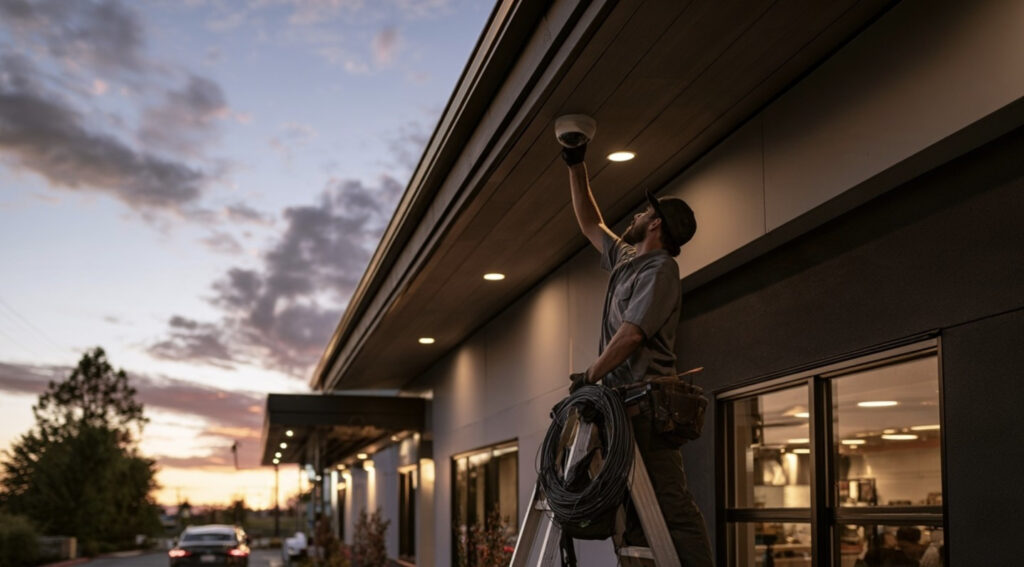
Most restaurant technology changes happen gradually. A new kiosk here, an app update there. The one now working its way through McDonald’s restaurants across the United States is different, because it has a hard date attached to it.
Under McDonald’s New Restaurant Building and Equipment Standards, known as NRBES, every restaurant is expected to have migrated its security cameras from analog CCTV to IP-CCTV by January 1, 2027. With roughly three months left, a lot of franchisees are finding out that the change is much bigger than it sounds.
Not a camera swap
On paper it looks like an equipment upgrade: take down the old cameras and put up new ones. In practice it is closer to rebuilding a system from the cabling up.
Analog cameras run over coaxial cable. IP cameras need a dedicated Cat5 or Cat6 Power over Ethernet run to each camera, and the old analog wiring cannot be reused. Most restaurants that were running analog systems simply do not have that infrastructure in the walls. Getting it there means new cable runs to every required camera position, which means time on site, access to the building and someone who knows exactly what the standard asks for.
That standard is specific. Coverage is required across sixteen zones: the parking lot, the pull-forward area, curbside, vehicle license plate capture, the lobby, the lobby entrance, the PlayPlace, the front counter, the cash booth, the presenter’s booth, the office, the back door, the side door, the trash corral, the crew room and the freezer. Recording requirements are just as precise: at least 90 days of retained footage for the office camera and 60 days for all remaining restaurant cameras. A system that misses a zone or falls short on storage is not compliant, even if every camera in it is IP.
Why the calendar is the real problem
For a single restaurant, the work is manageable. The standard does not set an installation time, but in the experience of Carolina Georgia Sound, one of the providers doing this work, a typical location takes about two to three days, covering the site audit, removal of the old system, new cabling, camera installation, recorder configuration and the documentation the franchisee hands to their Franchise Business Partner.
The difficulty is multiplication. At that pace, a franchisee with ten restaurants is looking at something like 20 to 30 installation days that all have to be scheduled around normal service. Restaurants cannot simply close for a camera project, so the work has to be sequenced location by location.
At the same time, only certified providers can do this work, and each has a finite number of technicians and installation days left before the end of the year. As more operators move from “we know we need to do this” to actually booking it, that capacity fills up. Operators who wait until late in the year may find there is no one available to do the job before the deadline.
What non-compliance actually means
Missing the date does not mean a restaurant is shut down. The official correction guidance gives operators 30 to 90 days to fix a flagged violation. But the consequences reach further than the cameras. NRBES compliance feeds into the Reinvestment National Franchising Standard assessment, which shapes how a franchisee is viewed by their Franchise Business Partner. For an operator with many locations, a flagged violation at one restaurant can affect the wider relationship, including future reinvestment conversations.
A bigger shift in how restaurants think about technology
The NRBES deadline is a useful window into a broader change. For years, restaurant technology was bought one piece at a time. Cameras came from one vendor, the drive-thru headsets from another, the network from a third and the point of sale from a fourth. Each was treated as equipment.
Standards like NRBES push operators toward treating technology as infrastructure instead: something planned across every location, built to a consistent specification and documented so anyone can understand what is installed where. It is the same thinking that has been reshaping back-office systems, as seen in how hospitality groups approach their software, which we looked at in 7 Misconceptions About Modern Hospitality ERP Software.
It also changes who operators want to work with. A camera project that touches cabling, the network and the recorder is exactly the kind of job where multiple vendors end up pointing at each other.
How one regional integrator is approaching the deadline
Carolina Georgia Sound, known to its customers as CGS, is one of the providers working through this deadline with franchisees. The company is based in Augusta, Georgia, has more than 35 years in commercial technology and holds OTP certification for McDonald’s work. It talks to McDonald’s operators across Georgia, South Carolina and Ohio every week, and its own read of the market is blunt: most franchisees have heard about the deadline, far fewer have booked the work.
CGS has built its NRBES 2027 compliance process around the problems described above. Every engagement starts with a site assessment against the NRBES zone and storage requirements. The old analog system comes out, new Cat5 or Cat6 PoE cabling goes in to every required zone, the IP cameras and recorder are installed and configured to the retention rules (at least 90 days for the office camera, 60 days for the rest), and the site is verified and documented for the franchisee’s Franchise Business Partner. In CGS’s experience, most single restaurants are done in two to three days, and for multi-unit operators the installations are sequenced across locations so that each restaurant keeps serving customers while the work happens.
What sets the approach apart is that CGS does not treat cameras as a standalone job. The same team installs and services drive-thru communication systems from HME and PAR, the restaurant network and wifi, digital menu boards, point of sale hardware and structured cabling. Under president Grant Wycliff, the company has organized itself around being a single partner for the whole technology environment, with the stated aim of sending qualified local technicians who fix the problem on the first visit. For a franchisee, that matters beyond the deadline. The cabling and network work done for NRBES is the same infrastructure the drive-thru and point of sale rely on, so the company that builds it is well placed to support everything that runs on it afterwards.
What operators should be doing now
For franchisees who have not started, the practical steps are straightforward:
1. Get every location assessed against the NRBES zone and storage requirements now, not in November.
2. Find out how much new cabling each site needs, since that drives both cost and installation time.
3. Book installation dates with a certified provider while capacity still exists, and sequence them so no two busy locations are disrupted at once.
4. Make sure every completed site comes with documentation ready for your Franchise Business Partner.
The takeaway
The January 2027 deadline is about cameras, but the lesson is bigger. Restaurant technology is no longer a collection of gadgets that can be replaced one at a time. It is infrastructure, it is increasingly governed by standards, and it rewards operators who plan across every location instead of reacting store by store. The franchisees who treat this deadline as a planning exercise rather than a last-minute purchase will be the ones who get through it without disruption.
