Image from: https://www.pexels.com/photo/modern-medical-equipment-near-samples-in-lab-5827325/
Manual counting of specialized solid doses drains lab labor and introduces compounding errors that compromise batch integrity. When you handle low-volume runs of potent actives, orphan drugs, or customized capsules, a variance of two units ruins the entire yield. Technicians repeatedly clean counting trays, verify weights on analytical balances, and juggle cross-contamination risks across fast-turnaround formulations.
These bottlenecks inflate operating costs and pull licensed personnel away from core compounding tasks. Resolving these small-batch counting challenges requires targeted equipment protocols and tight verification workflows designed specifically for low-volume throughput.
Why Small-Batch Counting Demands Higher Precision Than Commercial Packaging
Small-batch counting requires absolute precision because low-volume compounding lacks the statistical buffer of mass manufacturing, meaning a single missing capsule invalidates dose uniformity and ruins clinical yields. Precision determines batch release.
Commercial packaging plants calibrate rotary tablet counters for continuous runs of 50,000 to 500,000 units. In those environments, an error margin of 0.1% falls within standard bulk overfill tolerances. Clinical research facilities and 503A or 503B compounding pharmacies operate under entirely different constraints:
- Micro-Batch Sizing: Batches frequently range from 15 to 300 doses. Missing two units represents an unacceptable 1.3% variance on a 150-capsule run.
- Cost of Raw Materials: Active pharmaceutical ingredients (APIs) for orphan drugs and custom formulations often cost between $50 and $400 per gram. You cannot absorb loss through deliberate overfill.
- Strict Yield Reconciliation: Regulators require compounding personnel to account for every single unit. An unreconciled unit triggers mandatory deviation logs and internal reviews.
When an automated filler rejects five capsules out of a thousand, a packaging line absorbs it. In a lab running clinical phase-I supplies, losing five capsules halts a patient cohort.
Primary Drivers of Counting Inaccuracies in Low-Volume Runs
Manual spatula methods, optical sensor blinds, and electrostatic charge buildup represent the primary causes of count discrepancy in small batches. These physical variables degrade mechanical and manual counts alike.
Technicians confront distinct physical interactions when handling specialized dosage forms:
- Static Charge Generation: Gelatin and hypromellose (HPMC) capsules readily pick up triboelectric charges during dry-season handling. Charged capsules cling to acrylic tray sidewalls or jump past photo-eye sensors, causing missed counts or duplicate reads.
- Fragile Tablet Friability: Non-commercial, hand-compressed tablets break easily. Traditional vibratory bowl feeders chip delicate edges, creating dust that coats sensor lenses and registers false counts.
- Varied Translucency: Modified-release liquid capsules, softgels, and transparent two-piece capsules scatter infrared light differently than solid white tablets. Standard optical sensors fail to break the beam cleanly without specific emitter adjustments.
- Human Verification Fatigue: Counting identical small items across thirty small bottles produces eye fatigue. Technicians routinely lose track at unit 45 of a 60-count bottle, requiring a complete recount that slows output.
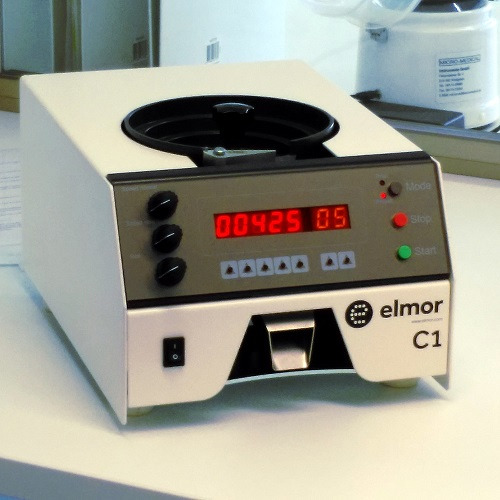
Image from elmor.com
Integrating Dedicated Microprocessor Counters into Small-Batch Workflows
Dedicated microprocessor counting units eliminate manual error by isolating individual solid doses along an adjustable conveyor bowl and registering parts through an optoelectronic sensor. This single-part singulation solves the counting bottlenecks inherent in manual trays and scale variance.
Systems like the Elmor C1 operate specifically within the low-to-medium volume gap where bulk commercial counters fail. Rather than requiring distinct format parts or interchangeable bowls for different capsule profiles, an adjustable single-bowl mechanism handles parts spanning 0.2 mm to 18 mm in diameter (with cylindrical capsules up to 20 mm in length):
- Single-Bowl Size Range: Technicians adjust one anodized aluminum bowl to move from 0.3 mm micro-pellets to size 000 capsules. This eliminates mechanical changeover downtime between different formulation geometries.
- Controlled Intelligent Deceleration: The integrated microprocessor automatically slows the vibratory conveyor speed as the count nears the preset target. This controlled deceleration prevents overshooting the batch size on small, exact orders.
- Dual Operating Modes: Operators can toggle between preset batch counts (up to 99,999) for direct vial packaging and totaliser mode for bulk API inventory audits.
- High-Accuracy Singulation: For spherical items down to 1 mm, the microprocessor achieves an error rate of 1 in 10,000 or lower. This precision satisfies stringent clinical accountability requirements without manual recounting.
Evaluating Small-Batch Counting Methods in Compounding Environments
Manual spatula counting, gravimetric verification, and benchtop optical counters represent the three primary methods for small batches, each carrying distinct operational trade-offs between capital cost, throughput speed, and cross-contamination risk.
Selecting the wrong method creates immediate labor bottlenecks or triggers regulatory non-compliance during audits:
- Manual Spatula and Tray Counting: The legacy baseline in retail and small 503A operations. While equipment costs remain near zero, processing speed tops out at roughly 6 to 10 units per minute under proper verification protocols. Cross-contamination risk remains acute without strict, validated cleaning intervals between active ingredients.
- Gravimetric Scale Verification: Analytical balances verify count by dividing total batch weight by average piece weight (APW). This method eliminates visual tracking errors and protects friable tablets from mechanical impact. However, individual capsule shell weight variations (often spanning +/- 3% to 5%) can produce a false count on batches under 100 units.
- Benchtop Optical Counters: Compact, single-channel or multi-channel units drop tablets through an infrared sensing curtain into bottles. They process 30 to 60 units per minute with verified single-unit accuracy. The operational trade-off centers on contact part cleanability. Systems requiring 20 minutes of disassembly and solvent washing between batches destroy throughput efficiency.
The following matrix compares common counting methods across critical compounding parameters:
| Counting Method | Throughput (Units/Min) | Setup & Line Clearance Time | Cross-Contamination Risk | Equipment Cost | Best Operational Fit |
| Manual Tray & Spatula | 6 – 10 | 2 – 5 minutes | High | Under $100 | Ultra-low batches (<30 units), non-hazardous APIs |
| Analytical Scale (Gravimetric) | 15 – 25 | 1 – 2 minutes | Low | $1,500 – $4,500 | Friable pressed tablets with uniform piece weights |
| Benchtop Optical Counter | 30 – 60 | 10 – 20 minutes | Medium to High | $3,000 – $9,000 | Repetitive small runs of identical formulation |
| Vision-Assisted Tray Scanner | 25 – 40 | 1 – 2 minutes | Very Low | $5,000 – $12,000 | Varied custom formulations, potent compounds |
Managing Cross-Contamination and Line Clearance Under USP <800> Standards
USP <800> compliance requires complete deactivation, decontamination, and cleaning of all counting equipment between batches to prevent hazardous drug residue transfer down to undetectable limits.
Handling hazardous active pharmaceutical ingredients (such as hormone replacements, antineoplastics, or potent immunosuppressants) complicates equipment selection. Technicians cannot simply wipe down a tray with isopropyl alcohol. Alcohol sanitizes; it does not deactivate chemical residues:
- Deactivate and Decontaminate: Apply an EPA-registered oxidizing agent, such as a sodium hypochlorite solution or hydrogen peroxide product, to destroy the active chemical structure on the contact surface.
- Clean Contact Surfaces: Wash the surfaces with a neutral detergent solution to mechanically lift and remove deactivated chemical residues and particulate matter.
- Rinse and Disinfect: Rinse thoroughly with purified water to remove detergent residue, then spray with 70% sterile isopropyl alcohol (IPA) and allow surfaces to dry completely before the next run.
- Dedicated Tooling Implementation: Maintain dedicated counting trays, funnels, and sensor chutes for specific hazardous drug classes. Color-code accessories to eliminate accidental tool swapping between hazardous and non-hazardous compounding hoods.
Image from: https://www.pexels.com/photo/computer-and-scanner-in-laboratory-17940257/
Standardizing Low-Volume Counting Protocols for Lab Yield and Safety
Protecting batch yield in compounding pharmacies and clinical facilities comes down to matching equipment to batch size, controlling static charges, and strictly enforcing contact-surface clearance. Manual counting trays carry low initial costs, but technician fatigue and cross-contamination risks quickly erode those savings.
Audit your current compounding log for count reconciliation deviations over the last six months. If staff spend more than fifteen minutes per batch reconciling counts or scrubbing down complex machinery, upgrade to dedicated, quick-strip optical counters or vision-assisted counting stations. Align your counting hardware with your cleanroom cleaning validation protocols to maintain regulatory compliance and protect patient safety.
Frequently Asked Questions
What is the acceptable error rate for solid dose counting in clinical trials?
Clinical trials permit zero error in dose counts. Investigational medicinal product (IMP) protocols require 100% reconciliation between bulk supplies, dispensed patient kits, and returned units. Any variance requires an immediate formal deviation report.
Why does static electricity cause counting errors on automated benchtop counters?
Static electricity creates triboelectric charges on gelatin and hypromellose capsule shells. Charged capsules cling to chute walls, bridge narrow feed channels, or drop in clusters rather than single files. This clustering blinds optical sensors, causing undercounts.
How does USP <800> impact equipment selection for counting hazardous drugs?
USP <800> requires dedicated, non-porous tools or equipment with fully detachable contact paths. Staff must decontaminate and wash contact parts with oxidizing agents between runs. Complex automated machines that require lengthy teardowns cause severe operational bottlenecks under these decontamination standards.
Can analytical balances replace manual counting trays for small capsule runs?
Analytical balances work well only if individual capsule shell weights remain consistent. Variations in empty capsule tare weights (often 3% to 5%) skew gravimetric piece-count calculations on batches smaller than 100 units. Visual verification remains necessary for ultra-small batches.
